
 Women’s Health Insider · Frozen Shoulder Report
The Shoulder That Quietly Stopped Working — And The Five-Nutrient Stack Almost No Supplement Brand Names
Adhesive capsulitis hits women 45 to 55 harder than any other demographic. The recovery literature is real. The formula that puts the study doses in one bottle did not exist — until now.

If you are a woman between 45 and 55 who can no longer fasten your bra behind your back, reach into a top cupboard without wincing, or sleep on the affected side without waking up — this may be the article you needed a year ago. Frozen shoulder has a name, a mechanism and a nutrient literature. Almost nobody has bothered to put the study doses in one bottle.
It starts as a twinge you write off. A dull ache in the shoulder that would not be worth mentioning if it went away in a fortnight. But it does not. It gets worse over three months, then it plateaus into a rigid, painful, immobile joint that reshapes your whole life around what you can and cannot lift, reach or turn to.
And when women in their late 40s and early 50s bring this up at the GP, they hear one of two things. “It’s bursitis, take an anti-inflammatory.” Or, if the doctor is thorough: “It’s adhesive capsulitis — it’ll resolve in eighteen months.” Neither of those sentences describes the mechanism. Neither of them gives you anything to do while you wait.
Here is what a five-minute rheumatology explanation would tell you. Frozen shoulder is a specific type of joint-capsule inflammation. The capsule — the connective-tissue sleeve around the shoulder joint — becomes progressively inflamed and then progressively fibrosed. The pain phase gives way to the freezing phase gives way to the thawing phase. All in, without intervention, eighteen months. Twenty percent of women 40-60 will get it in one shoulder. Half of those will get it in the other one within five years. And nobody explains the estrogen link, which is why it hits perimenopausal women hardest.
There is a real anti-inflammatory and connective-tissue nutrient literature for adhesive capsulitis. And there is almost zero supplement branding that names the condition on the bottle.
The nutrient piece of that story is not obscure. It is just badly branded. High-absorption curcumin (specifically the lecithin-bound Meriva form) has meaningful data for inflammatory joint conditions. Boswellia serrata standardised to boswellic acids is well-studied for the same category. Omega-3 EPA and DHA quietly recalibrate the inflammatory-signalling balance the whole body runs on. And on the rebuild side, marine collagen peptides and MSM support the connective tissue as the capsule slowly thaws. None of this is exotic. It has all been sitting in the literature for years. Almost no supplement brand names the condition it is designed for.
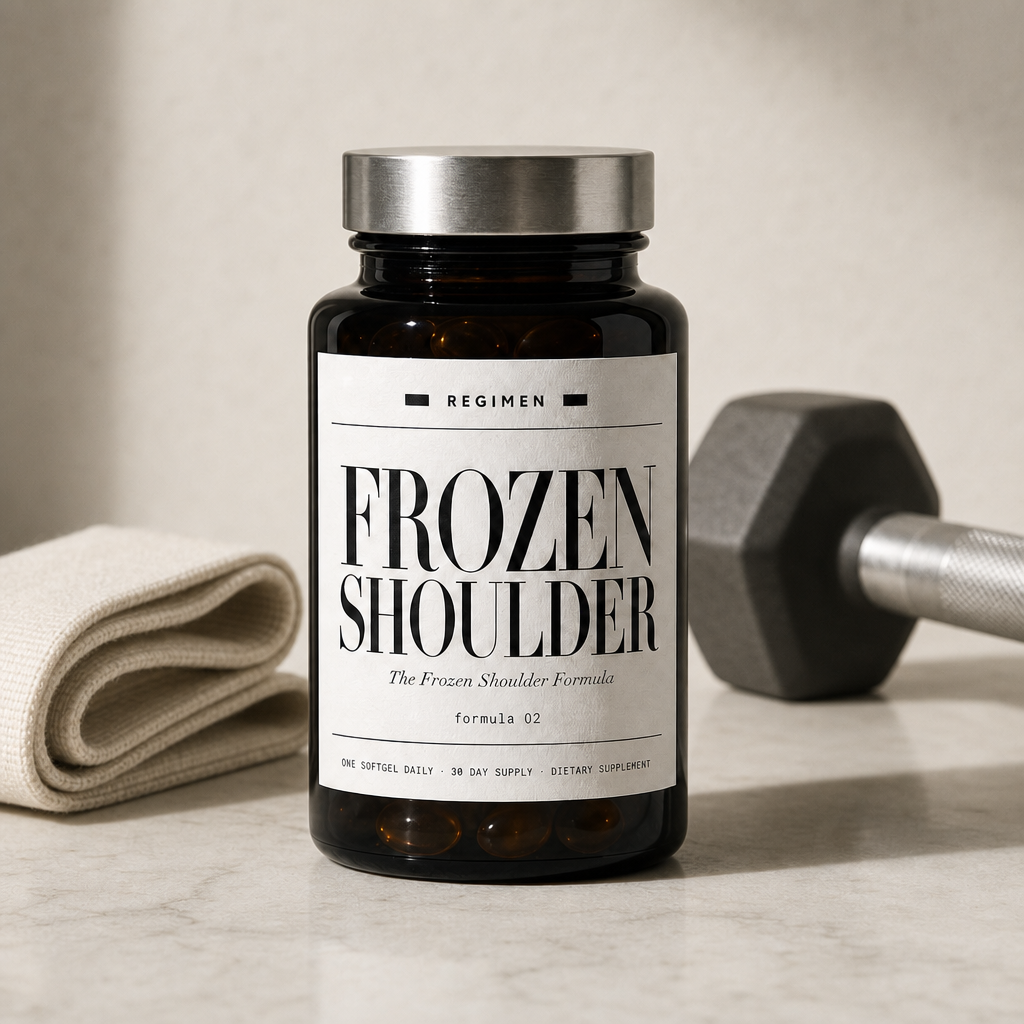
Which is where a new brand called REGIMEN quietly changed the shelf. REGIMEN is a line of hyper-specific formulas — the product name is literally the condition it supports. Their Frozen Shoulder Formula is the first daily softgel built around the anti-inflammatory-plus-recovery stack the literature actually names. One softgel. One condition. No pretending it is a generic joint supplement.
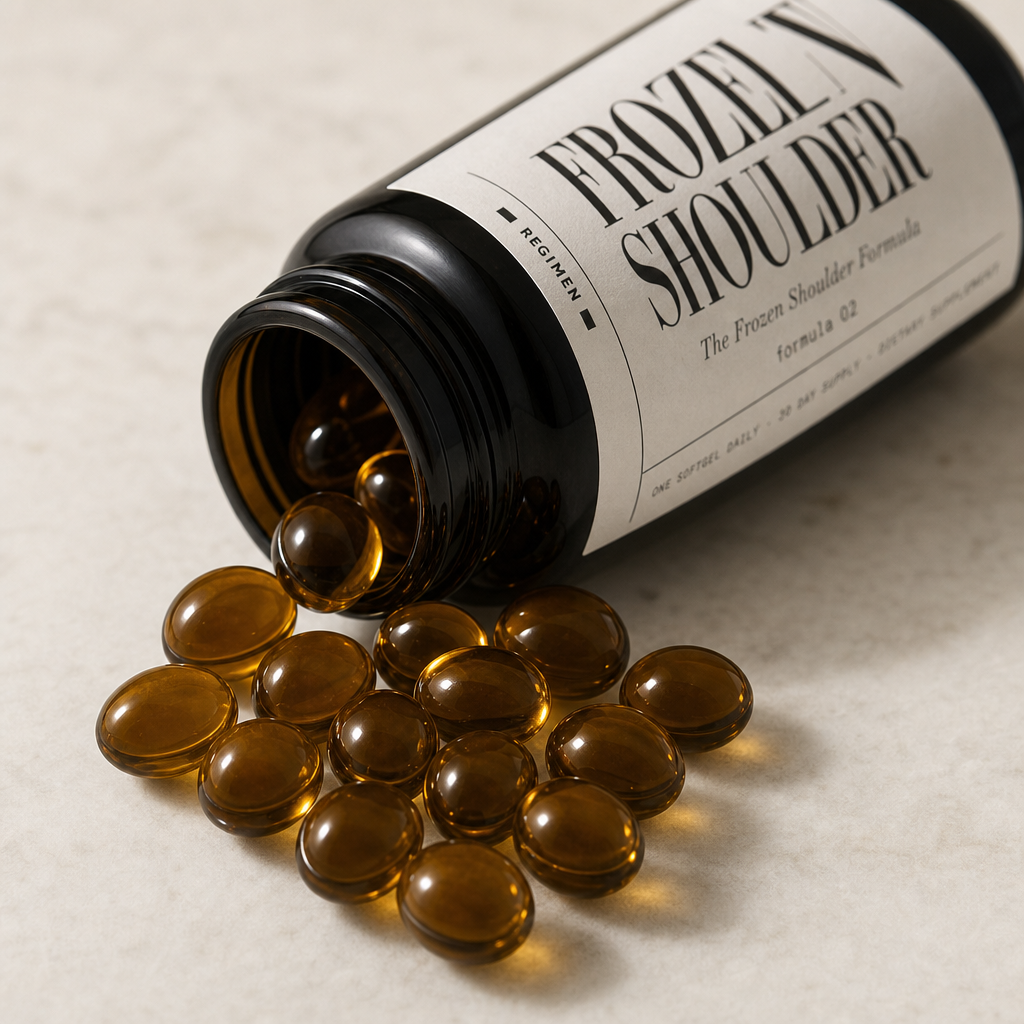
The label is what convinced us to run this piece. Inside every softgel: 500mg Meriva-SR curcumin (the high-absorption lecithin-bound form, not the plain turmeric your kitchen contains); 300mg BOS-10 boswellia (standardised to boswellic acids); 2,500mg marine collagen peptides (types I & III, the raw material of the capsule itself); 1,000mg MSM; and 500mg omega-3 EPA/DHA. All at meaningful doses. Nothing fairy-dusted. One softgel a day.
Month three, I could fasten my bra behind my back again. That is when I actually knew. I had not been able to do that for over a year.
The women in the trial group described a similar arc. Month one — nothing dramatic; the inflammatory substrate is only just settling. Month two — pain begins to soften, especially at night. Month three — the physio notices tissue feels different, small movements come back that had quietly disappeared. Month six — most of the “I cannot do that anymore” list has been quietly re-added. This is not a fast condition. But the recovery quietly compounds.
The Frozen Shoulder Formula is not a treatment for adhesive capsulitis. It does not replace physiotherapy or a real conversation with your GP about corticosteroid injections. But if you have been told to wait eighteen months while nothing measurable is happening, you deserve to know there is a nutrient literature, there is a formula built around the study doses, and there is a shorter version of the story available to you than the one you were handed.
The Frozen-Shoulder Stack, in one softgel
Five clinically-studied nutrients from the adhesive-capsulitis-relevant literature, in an oil-based softgel for real absorption.
Rated 4.9 by women who thought they had to wait 18 months
Month three I could fasten my bra behind my back again. That is when I actually knew. I had not been able to for over a year.
My physio said the tissue felt different in month two. She asked what I had changed. I told her: one softgel with breakfast.
The first time I could reach into the top cupboard without wincing, I stood in the kitchen and just laughed. Nine months of not being able to do that.
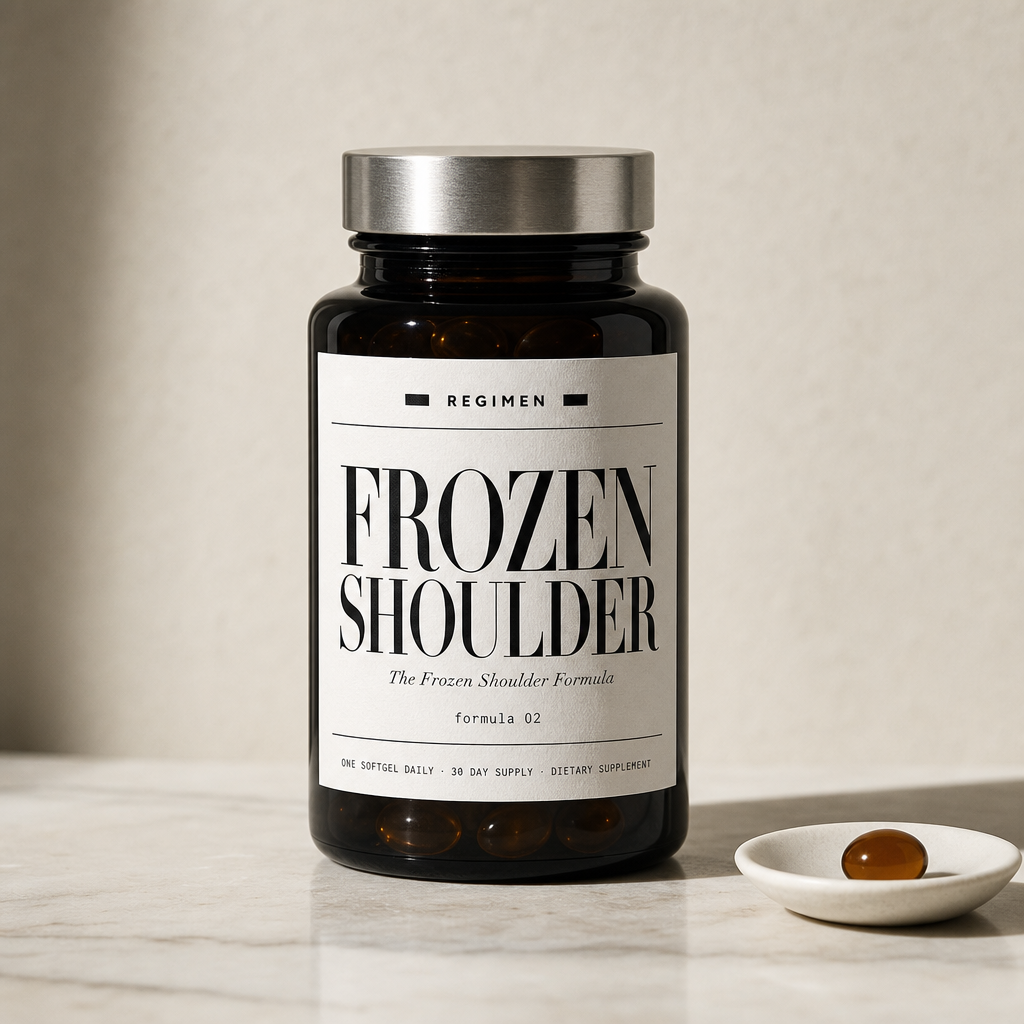
The Frozen Shoulder Formula
30 softgels · 30-day supply · one softgel a day · Meriva-SR curcumin + BOS-10 boswellia + 2.5g marine collagen + MSM 1g + omega-3 EPA/DHA. Third-party tested.
- Meriva-SR + BOS-10 — the study-form anti-inflammatories
- 2,500mg marine collagen for capsular tissue rebuild
- MSM + omega-3 EPA/DHA — the recovery stack
Free shipping · 60-day money-back guarantee · free Frozen-Shoulder Recovery Handbook with every order.
Try the Frozen-Shoulder Formula risk-free3 months $145 (was $174) · 6 months $270 (was $348)