
 Women’s Health Insider · Bone & Mobility Report
Why Women Shrink an Inch a Decade After 55 — And How to Stop It Before It Becomes a Broken Hip
Half of all women over 50 will fracture a bone because of osteoporosis. Most will not know their bones are dissolving until the day it happens. Here is what your GP will not book an hour to explain — and the two-minute morning habit that changes the story.

If you are a woman over 55, this may be the single most important paragraph in this report. Half of all women in developed countries will break a bone because of osteoporosis. Most will not have any warning. The first sign is often the fall. And the years between menopause and that fall are the years when everything is quietly, invisibly decided. This is how the story actually works — and how it can go differently.
The scariest part of post-menopausal bone loss is not the statistic. It is the silence. Bones do not ache when they thin. They do not warn you. You do not feel the density dropping year after year. And then one morning you slip on the wet floor of a hotel bathroom in Barcelona and your femur gives way, and your independence — the thing you spent forty years building — is gone in one afternoon.
For a generation of women in their late 50s and 60s, this timeline is not talked about with anything like the urgency it deserves. You get a bone-density scan at 65, maybe. You get told your numbers are “on the low side.” You get sent home with a leaflet about milk. What you do not get told is that in the ten years between menopause and that scan, you were losing up to 20% of your bone mass — and that window is when the damage is prevented, not after.
Here is the mechanism nobody in a fifteen-minute appointment has time to explain. When estrogen collapses at menopause, so does the “build” signal to your bones. Bone is not static — it is constantly being torn down and rebuilt. After menopause, the tear-down keeps going and the rebuild slows to a crawl. Meanwhile, three nutrients your bones absolutely require to rebuild — vitamin D3, vitamin K2, and magnesium — are almost universally deficient in women over 55. Not slightly low. Deficient.
Half of all women over 50 will fracture a bone because of osteoporosis. The window to prevent it is the ten years right after menopause — the exact window most women coast through.
You cannot rebuild bone with calcium alone. Every 55-year-old woman knows the “drink more milk” line by heart, and it turns out to be almost the least important part of the story. Calcium without vitamin K2 goes to the wrong places — into your arteries instead of your bones. Vitamin D3 without K2 has the same problem. And magnesium — the mineral that literally activates the enzymes that build bone — is missing from almost every women’s multivitamin on the shelf. The dietary advice we grew up on was not wrong. It was just embarrassingly incomplete.
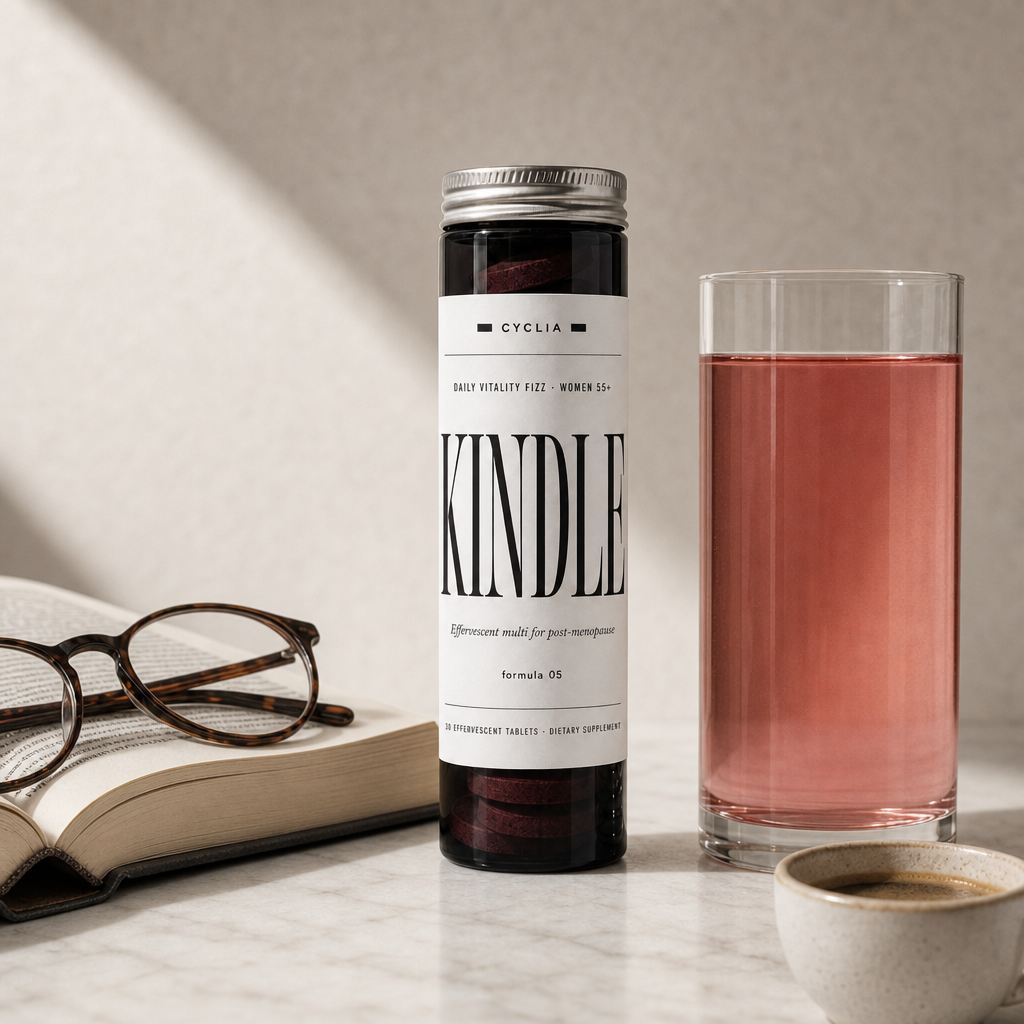
Which is where a small Australian brand called Cyclia quietly changed the game. Their new formula — Kindle — is the first daily supplement built specifically for the post-menopausal restoration window. Not another handful of pills. One effervescent tablet dropped into a glass of water beside your morning coffee. It fizzes. You drink it. That is the entire routine.
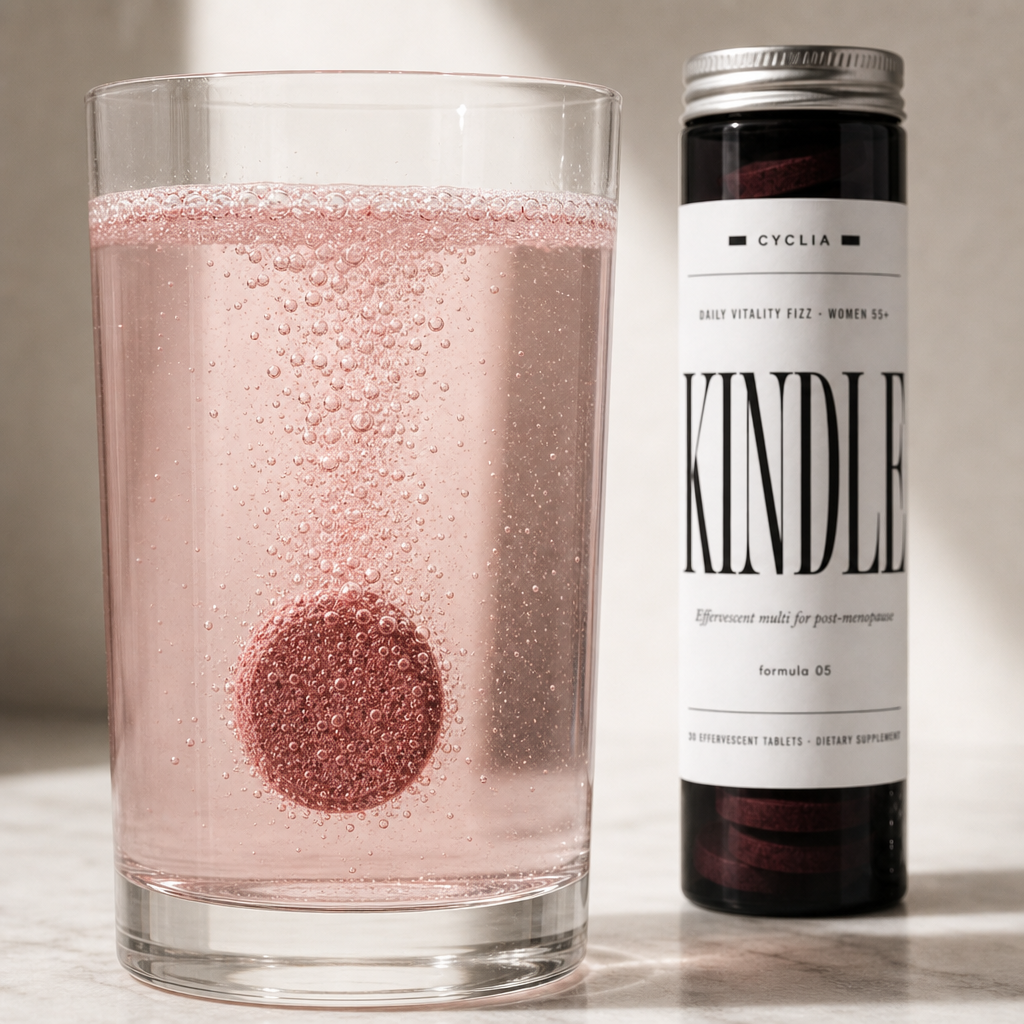
What convinced our editorial team was that the bone stack is not treated as an afterthought — it is treated as the point. Kindle contains Vitamin D3 (2000 IU) with K2 (MK-7) — the pair that directs calcium into bone, not artery. Magnesium glycinate at a real dose — the mineral that switches on the enzymes that build new bone. Marine collagen peptides for the protein matrix bone actually grows on. And the full vitality stack on top — activated B-complex, CoQ10, KSM-66 ashwagandha and omega DHA — because a body that is sleeping, thinking, and moving well is a body that rebuilds bone better.
By the second scan my numbers had stopped falling for the first time in fifteen years. My doctor asked what I had changed. I told her: one glass of water in the morning.
The women in the trial group described a similar arc. Month one — sleep and energy improve first; bones are slow. Month three — grip strength returns, joints ache less, morning stiffness fades. Six to twelve months — where the bone-density conversation actually begins, and where women start returning to their GPs with numbers that have stopped falling. This is not fast work. But it is work that pays back for the rest of your life.
Post-menopausal bone loss is not inevitable, and the window to change the story is the window most women are told nothing about. Kindle is not a prescription and it will not replace a real conversation with your GP about a DEXA scan or hormone therapy. But if you have quietly assumed that shrinking, stiffening and fearing the fall is “just what happens” — you deserve to know there is a stack of nutrients your body has stopped receiving, and there is a two-minute morning habit that changes the trajectory of your seventies before you ever get there.
The bone-restoration stack
One effervescent tablet — the specific set of nutrients your post-menopausal bones need to keep rebuilding.
Rated 4.9 by women who thought shrinking was inevitable
By the second DEXA scan my numbers had stopped falling for the first time in fifteen years. My doctor asked what I had changed. I told her: one glass of water in the morning.
I lost my mother to a fall when she was 74. I have quietly been terrified of my seventies for a decade. Kindle is the first thing I have found that actually addresses the biology, not the leaflet.
My grip strength came back before anything else. I could open a jam jar. Small thing. But I hadn’t realised how much I had adjusted around not being able to.
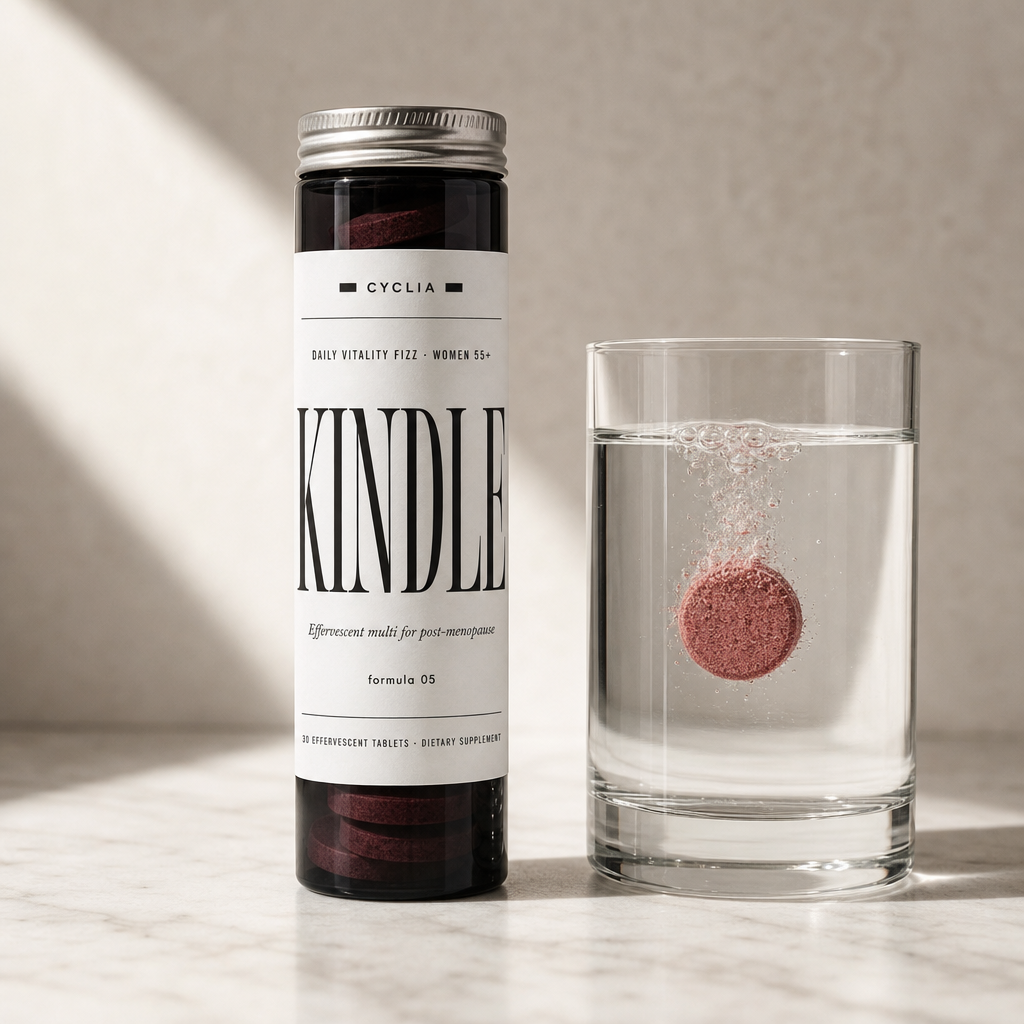
Kindle — Daily Vitality Fizz for Women 55+
30 effervescent tablets · 30-day supply · one glass a day · D3+K2 + magnesium glycinate + marine collagen · vegan-friendly formula · third-party tested.
- D3+K2 signalling pair for bone-directed calcium
- Magnesium glycinate for bone-building enzymes
- Marine collagen for the bone protein matrix
Free shipping · 60-day money-back guarantee · free Post-50 Vitality Handbook with every order.
Try Kindle risk-free3 months $120 (was $144) · 6 months $220 (was $288)